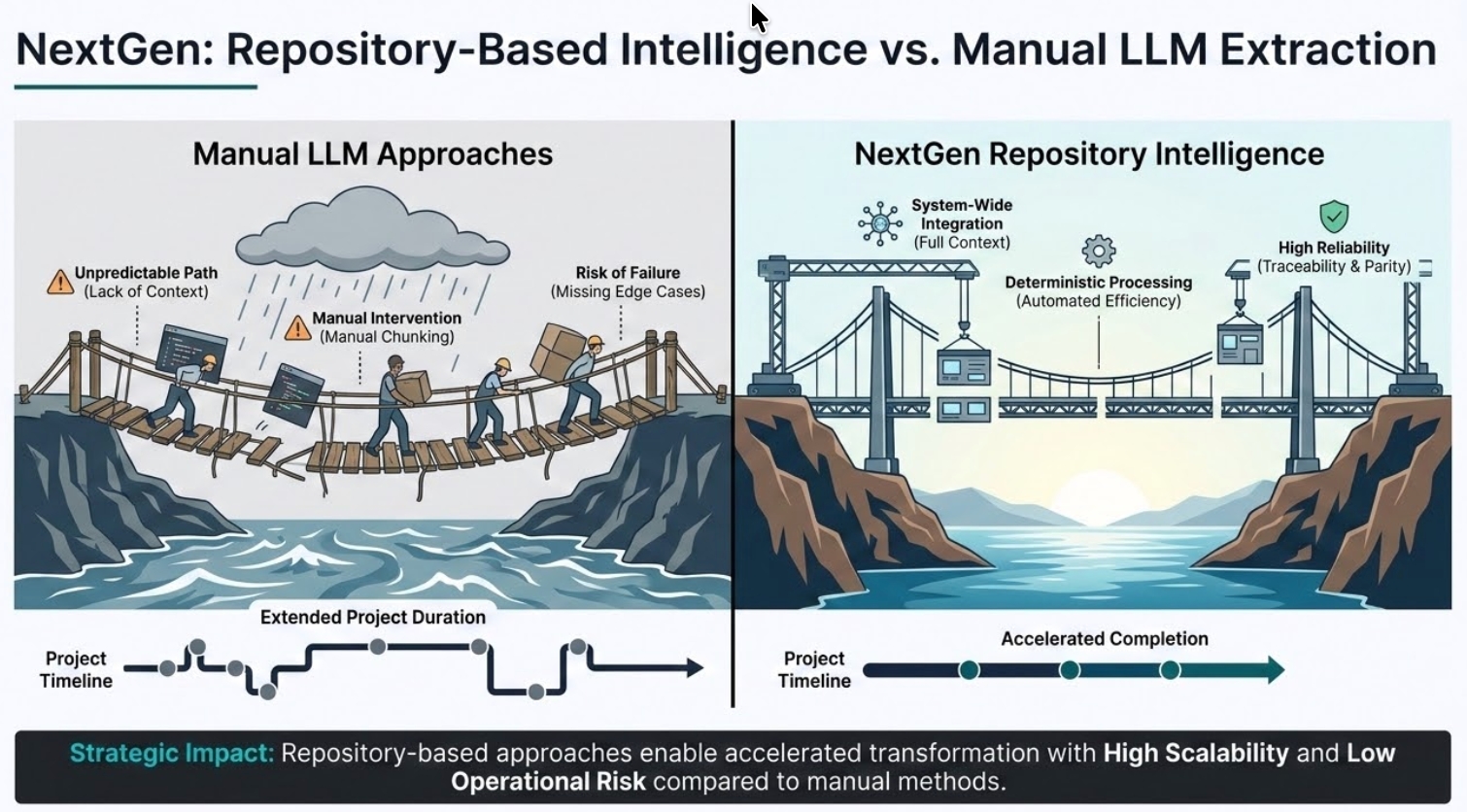
Why Manual Code Knowledge Extraction Falls Short
Standalone LLM Interfaces vs Repository-Based Intelligence Platforms
Executive Summary
Enterprises operating legacy systems face a growing challenge: understanding and extracting meaningful business knowledge embedded within decades of code. Traditionally, this has been addressed through manual analysis—relying on subject matter experts (SMEs), code walkthroughs, and documentation efforts. While workable at small scale, manual approaches are increasingly ineffective in modern transformation initiatives.
Repository-based intelligence platforms, such as NextGen, offer a fundamentally different paradigm. By systematically ingesting, structuring, and analyzing codebases, these tools provide scalable, consistent, and context-aware insights. This paper explores why manual methods fall short and how repository-driven approaches deliver superior outcomes.
1. The Nature of Legacy Code Knowledge
Legacy systems (COBOL, CA Gen, PL/I, RPG, etc.) encapsulate:
- Business rules accumulated over decades
- Implicit dependencies across modules
- Data transformations and lineage
- Operational workflows and edge-case handling
This knowledge is:
- Poorly documented
- Distributed across multiple artifacts
- Context-dependent and often implicit
Extracting it accurately requires not just reading code, but understanding relationships across the entire system.
2. Manual Extraction Using Standalone LLM Interfaces
2.1 Typical LLM-Driven Manual Process
- Developers copy/paste code snippets into tools like ChatGPT or Claude
- Prompt the model to summarize logic or extract business rules
- Iterate prompts to refine outputs
- Manually stitch together insights across multiple files/modules
- Store results in documents or spreadsheets
2.2 Key Limitations
Lack of System Context
Standalone LLMs operate on limited input windows. Even with large context sizes, they cannot reliably capture:
- Full call chains
- Cross-program dependencies
- End-to-end data lineage
This leads to fragmented and sometimes misleading summaries.
Prompt Sensitivity and Variability
Outputs depend heavily on how prompts are written. Different users or prompt styles produce:
- Inconsistent interpretations
- Variability in rule extraction
- Difficulty standardizing outputs across teams
Manual Chunking Problem
Large codebases must be broken into smaller chunks to fit into LLM context windows. This introduces:
- Loss of continuity
- Missed interdependencies
- Increased manual effort to reconcile outputs
No Persistent Knowledge Model
Standalone interfaces do not build a reusable knowledge base:
- Each query is stateless (or weakly stateful)
- Insights are not automatically linked
- No cumulative system understanding is formed
Limited Traceability
While LLMs can summarize code, they typically:
- Do not maintain structured links back to source locations
- Make validation and auditing difficult
Human-in-the-Loop Overhead
Users must continuously:
- Craft prompts
- Validate outputs
- Cross-reference results
This reduces productivity gains and introduces human error.
Scalability Constraints
Applying this approach across thousands of programs results in:
- High operational overhead
- Inconsistent coverage
- Difficulty managing large-scale transformations
Risk of Hallucination and Omission
LLMs may:
- Infer logic that does not exist
- Miss edge cases or conditional paths
Without system-wide grounding, accuracy is not guaranteed.
3. Repository-Based Intelligence Platforms (e.g., NextGen)
Repository-based platforms take a model-driven approach:
- Ingest code into a structured repository
- Parse and normalize constructs (procedures, data elements, rules)
- Build relationships (call graphs, data lineage, dependencies)
- Apply analytics and AI for summarization and insights
Core Capabilities
- Centralized knowledge repository
- Automated parsing and indexing
- Cross-referencing across the entire system
- Continuous updates as code evolves
4. Advantages Over Manual Methods
4.1 System-Wide Context
Repository-based tools analyze the entire codebase simultaneously, preserving relationships such as:
- Call chains
- Data lineage
- Cross-module dependencies
This enables accurate, holistic understanding.
4.2 Consistency and Standardization
Automated extraction applies uniform logic, ensuring:
- Consistent summaries
- Standardized rule classification
- Repeatable outputs
4.3 Scalability
These platforms can process millions of lines of code efficiently, enabling:
- Full-system coverage
- Faster turnaround times
4.4 Dynamic and Queryable Knowledge
Unlike static documents, repository-based outputs are:
- Searchable
- Filterable
- Continuously updated
Users can query the system for specific rules, data elements, or flows.
4.5 Traceability and Auditability
Every extracted insight is linked back to source artifacts, enabling:
- Verification
- Impact analysis
- Regulatory compliance
4.6 Reduced SME Dependency
SMEs shift from manual extraction to validation and refinement, improving efficiency and reducing risk.
4.7 Integration with Modern Tooling
Repository-based outputs can integrate with:
- JIRA / Azure DevOps
- API generation frameworks
- Documentation systems
This bridges legacy understanding with modern engineering workflows.
4.8 Reliability and Risk Reduction Through Automation
Automated repository-based platforms such as NextGen significantly reduce transformation and interpretation risks by introducing system-level controls that manual or LLM-only approaches lack.
Automated Cross-Referencing
- Ensures all logic is analyzed in relation to its upstream and downstream dependencies
- Prevents orphaned or partially understood rules
- Identifies hidden couplings across modules
Parity Checks and Completeness Validation
- Verifies that extracted rules align with actual implementation
- Detects missing branches, conditions, or edge cases
- Ensures coverage across the entire codebase rather than sampled subsets
Deterministic Processing vs Probabilistic Interpretation
- Repository tools rely on parsed structures and metadata
- Eliminates variability introduced by prompt-based interpretation
- Produces repeatable and auditable outputs
Impact Analysis and Change Safety
- Automatically identifies all affected components when a rule or data element changes
- Reduces regression risk during modernization or refactoring
Data Lineage Integrity
- Tracks how data flows across programs, transformations, and storage
- Prevents misinterpretation of critical business calculations
Reduction of Hallucination Risk
- Outputs are grounded in parsed code artifacts rather than inferred context
- Minimizes incorrect assumptions often seen in standalone LLM outputs
Continuous Validation
- As code evolves, the repository updates and revalidates relationships
- Prevents knowledge drift over time
Governance and Compliance Support
- Enables audit trails linking business rules to implementation
- Supports regulatory requirements for traceability and validation
Operational Risk Reduction
- Decreases reliance on individual expertise
- Reduces single points of failure (SMEs or prompt engineers)
- Improves confidence in large-scale transformation initiatives
5. Quantitative Comparison
| Dimension | Manual Methods | Repository-Based Tools |
|---|---|---|
| Scalability | Low | High |
| Consistency | Variable | High |
| Context Awareness | Limited | Comprehensive |
| Time to Insight | Slow | Fast |
| Traceability | Weak | Strong |
| Reusability | Low | High |
| Maintenance | Manual | Automated |
6. Strategic Implications
Organizations relying on manual methods face:
- Slower modernization timelines
- Higher costs
- Increased risk of incomplete understanding
In contrast, repository-based approaches enable:
- Accelerated transformation
- Better decision-making
- Improved alignment between business and IT
7. Conclusion
Manual extraction of knowledge from legacy code is inherently limited by scale, subjectivity, and lack of context. While it may provide short-term insights, it cannot support the demands of modern digital transformation.
Repository-based intelligence platforms such as NextGen represent a necessary evolution. By turning code into a structured, queryable knowledge base, they unlock the full value of legacy systems and enable organizations to modernize with confidence, speed, and accuracy.
Turn code into a structured, queryable knowledge base — and modernize with confidence, speed, and accuracy.
About This Perspective
This whitepaper reflects industry best practices in legacy modernization, model-driven engineering, and AI-assisted code analysis. It is particularly relevant for enterprises working with platforms such as CA Gen, COBOL, and other legacy ecosystems where business logic is deeply embedded in code.