Reimagining Legacy Modernization: Reducing Risk and Accelerating Transformation
With AI-Driven Intelligence
Introduction: The Modernization Imperative
Modernizing legacy applications is no longer optional—it's a strategic necessity. Enterprises today face mounting pressure to improve agility, reduce operational costs, and align with evolving digital ecosystems. Yet, despite the urgency, modernization remains one of the most complex and risk-prone initiatives organizations undertake.
Why Legacy Modernization Is So Challenging
At its core, legacy modernization is daunting because of a combination of structural and organizational barriers:
- Deep System Complexity: Legacy systems often span decades of layered logic, tightly coupled components, and undocumented dependencies.
- Limited Knowledge and SME Dependency: Critical system knowledge resides with a shrinking pool of subject matter experts (SMEs), making progress slow and expensive.
- Disappearing Institutional Knowledge: Attrition and retirements result in irreversible loss of undocumented business logic.
- Resource Constraints: Modernization efforts compete with ongoing operational priorities, limiting available bandwidth.
The result is a high-risk environment where missed requirements and incomplete understanding can derail transformation initiatives.
Shift Toward COTS-Based Modernization
To address these challenges, organizations are increasingly adopting Commercial Off-The-Shelf (COTS) solutions.
Why COTS Is Gaining Traction
- Proven, enterprise-grade platforms
- High flexibility through configuration
- Strong vendor support and ecosystem
- Faster time-to-value compared to full redevelopment
However, the real challenge lies in accurately mapping legacy business rules into COTS configurations—a process that is often manual, error-prone, and resource-intensive.
The Hidden Risk: Loss of Business Rules
A major risk in modernization is the loss or misinterpretation of business rules embedded deep within legacy systems.
Missing even a small subset of rules can lead to:
- Functional gaps
- Compliance failures
- Operational disruptions
Ensuring complete rule discovery and accurate transformation is therefore critical to success.
AI-Powered Acceleration with NextGen
AI-driven platforms like NextGen fundamentally transform how organizations approach modernization.
Comprehensive Knowledge Capture
NextGen ensures:
- Complete extraction of business rules
- Preservation of institutional knowledge
- Clear mapping of dependencies and relationships
Accelerated Discovery and Requirement Generation
NextGen automates:
- Rule extraction
- Requirements creation
- System understanding
Measured Impact: 60–70% savings in effort, cost, and time for rules discovery and requirements engineering
Reduced Transformation Risk
By ensuring completeness and accuracy, NextGen significantly reduces:
- Missed requirements
- Rework cycles
- Downstream defects
TransformX: From Understanding to Execution
The TransformX module, part of the NextGen suite, extends capabilities from analysis into execution.
Key Capabilities
- Auto Component Identification: Automatically identifies logical components within legacy systems.
- Target Architecture Blueprinting: Generates a structured blueprint of the future-state architecture.
- Service-Level Code Generation: Accelerates modernization through automated code generation aligned with modern architectures.
- COTS Mapping Using Product Taxonomy: A key differentiator:
- Maps extracted business rules directly to COTS configuration containers
- Uses COTS product taxonomy for precise alignment
- Simplifies customization and reduces manual intervention
Impact
TransformX enables faster, more accurate modernization with reduced complexity and risk, particularly in COTS-driven transformations.
A Technological Edge: Agentic AI Framework
NextGen stands apart through its advanced technology foundation:
- Agentic AI Framework: Autonomous agents orchestrating complex analysis and transformation workflows
- Large Language Models (LLMs): Deep contextual understanding of legacy code and embedded business logic
- Fuzzy Logic Engine: Handles ambiguity, incomplete documentation, and variations in implementations
Combined Advantage
This integrated approach delivers:
- Rapid knowledge extraction
- High accuracy in rule interpretation
- Intelligent transformation mapping
Conclusion: From Risk to Confidence
Legacy modernization does not have to remain a high-risk, resource-intensive endeavor.
With NextGen, organizations can achieve:
- 60–70% savings in discovery and requirements engineering effort
- 40–50% overall acceleration in modernization outcomes, especially in COTS-aligned transformations
By combining AI-driven intelligence with structured transformation capabilities, enterprises can:
- Modernize with confidence
- Preserve critical business logic
- Reduce cost and timelines significantly
- Accelerate adoption of modern architectures and COTS platforms
The future of modernization is not just faster — it is smarter, safer, and far more predictable.
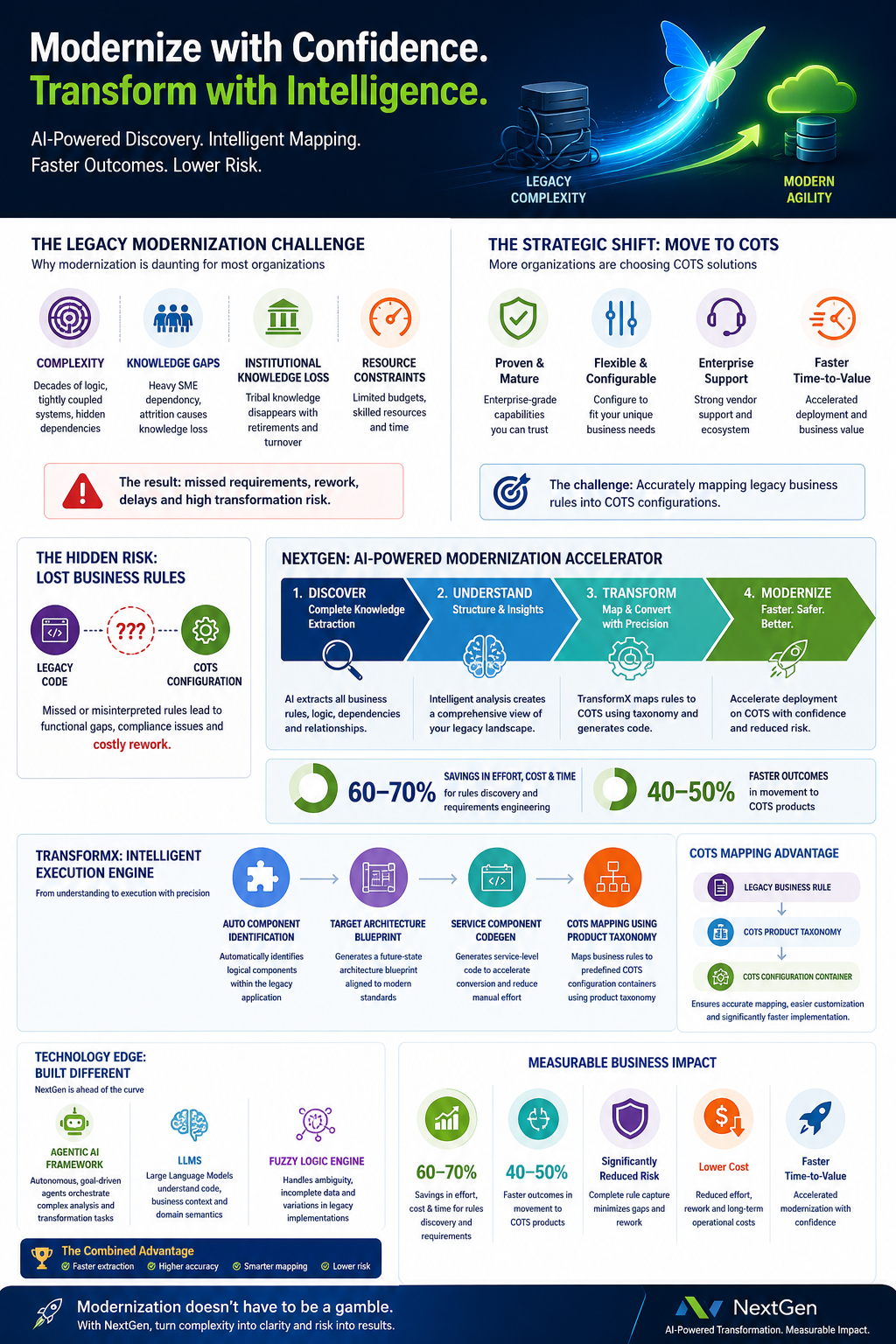
NextGen: AI-Driven Legacy Modernization Platform